A Review of “Freedom is a Constant Struggle” by Angela Y. Davis
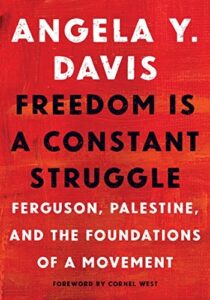
Angela Davis, in her book, “Freedom is a Constant Struggle” reflects on the intersectionality of struggles and although many pivotal moments in policy and protest may seem to be isolated, they are interconnected in various ways. This book is actually a collection of interviews and speeches where Davis talks about how important it is to organize and mobilize to pursue change, and to question institutions that we are told exist for the greater good. Multiple times in the book she refers to abolitionism, which refers to prison abolition, and the G4S, which she states as, “the third-largest private corporation in the world” (Davis, p. 55) with its influence being found throughout the United States and the world under the guise of “security”. Her chapters refer to capitalist individualism, the prison-industrial complex, recognizing the need for systemic change, and to contextualize this as being a global struggle, requiring transnational solidarity.
In regards to the author, the book describes Angela Davis as follows:
Angela Y. Davis is a political activist, scholar, author, and speaker. She is an outspoken advocate for the oppressed and exploited, writing on Black liberation, women’s liberation, prison abolition, and international solidarity with Palestine. She is the author of several books … and is professor emerita at the University of California, Santa Cruz.
In the book, Davis mentions her involvement with Communist Party and the Black Panther Party, and how she had found herself on the FBI’s Ten Most Wanted criminal list, and was represented as being armed and dangerous. I’m of an age where my only knowledge of communism is in regards to the Soviet Union. Clearly there is a more nuanced definition that I’m missing, as her activism appears to be anything like the evil, suppressive regime that ran the USSR.
Davis takes issue with the term “terrorist”, as she reminds us that Nelson Mandela, recognized today as a hero for civil rights, was considered a “terrorist” until 2008. This is even after his release in 1990 and subsequently becoming South Africa’s president. Before 2008, his ban from visiting the US had to be expressly waived. This should reveal how casually we apply the term “terrorist” in the United States — when an activist gets called a “terrorist”, it probably means they’ve created enough awareness to worry the establishment.
Davis discusses G4S, which is now owned by Allied Universal (Allied Universal, 2021), and claims to be the third largest employer in North America. According to Davis, G4S has deep involvement in the global prison-industrial complex, and how they are blurring the boundary between schools and jails. She even mentions how G4S has offered guns and target practice to teachers (Davis, p. 56). She adds that they provide transportation of deportees back to Mexico, and are involved in mental health care services, like Central Pasco Girls Academy which serves moderate-risk females, ages 13–18. G4S, she adds, runs prisons in Palestine, and is involved in checkpoint technology, and has been involved in the deaths of undocumented immigrants. Davis points out that G4S is the largest employer on the entire continent of Africa. Imagine the resistance from G4S if we were to abolish for-profit incarceration, or eliminate the apartheid in Palestine.
In terms of intersectionality and transnational solidarity, Davis reminds us how the Palestinian people provided assistance to the protestors in Ferguson, after the murder of Michael Brown. They saw the footage of protestors being subjected to tear gas, and recognized the gas cans as the exact “brand” of weaponry used on them. They reached out to the Ferguson protestors and informed them on how to deal with the gas, and strategies to use to prevent the police from using the gas in the first place, such as staying close to the police so they would be reluctant to gas themselves. Davis suggests that, as we can learn from the Palestinians in their protests, the Palestinians are able to learn from us through our protests. Davis specifically refers to feminism in this comparison, but I think it is appropriate as a general approach to activism.
Davis shares an interesting fact that, stating there are over 450,000 Palestinians in Chile, and how, even though he was known for violating human rights, they supported the dictator, Augusto Pinochet. According to Davis, Palestinians in Chile had amassed wealth and privileges that they were reluctant to lose.
There are many aspects of our history that I never knew. For example, she mentions Harriet Tubman as being a soldier who finally received a pension from her service. And while I hadn’t heard of this boycott, Davis points out that Dr. Martin Luther King Jr. is often associated with the 1955 Montgomery Bus Boycott, but that movement was already underway, and started by women who invited him to participate in the boycott. Angela Davis shares many historical references, and one of them, known as “the kissing case” piqued my interest, so I looked it up. She cites this case as, “In Monroe, North Carolina, in 1958, a young Black boy about six years old kissed a white girl with whom he was playing and was arrested on attempted rape charges.” (Davis, p. 113) I looked this up, and found quotes from the, now men, who were arrested in this case, and it was actually two boys, not one. James was 9, and David was 7 and a White girl was pressured by her friends to kiss the boys, and she kissed each of them on their cheeks. She later told her parents, and the parents became furious, and contacted the police (NPR, 2011). I couldn’t help but think about Dick Rowland, the 19 year-old shoe shiner in Tulsa back in 1921, and how that was the catalyst for what became known as the Tulsa Massacre.
Of all the knowledge shared in this book, one of the biggest take-aways is how we cannot expect change to come from an individual. Davis refers to the Emancipation Proclamation, and how it didn’t abolish slavery—it was actually a military strategy, and we need to examine its failures (Davis, p. 69). There were exemptions in the proclamation that left 750,000 people in bondage. It took movements of many people, the oppressed people, and in many ways it shows how representation within the movement helps make for significant progress. This mirrors the argument for the Autistic Self Advocacy Network’s motto of, “Nothing about us without us”, where you should have a seat at the table if you want things to get done for your demographic. It’s a great example of how successful a combination of active and passive representation can be.
In regards to representation within police departments, Davis (2016, p. 138) also mentioned how racism that criminalizes communities of color isn’t limited to white police officers, and even though they may be influenced by this racism, it was not their individual idea to do this. Nicholson-Crotty, et al. (2017) concluded that, “… black police officers may be more likely to discriminate against black citizens because of increased pressure to adopt an organizational role that prescribes such behavior.”
There was a lot of information in this book. She recalls historical events, authors from all over the world, and historical figures we should probably know, like Claudette Colvin who refused to move to the back of the bus before Rosa Park did. I had never heard of the children’s marches in Birmingham, or the bombing of the Sixteenth Street Baptist Church. I had never heard of the idea shared in a book by Craig Wilder, that Ivy League universities were founded on and deeply implicated in the institution of slavery. And while this is by no means an exhaustive list of topics, the listing of the Ten-Point Program of the Black Panther Party was quite a surprise. It was chilling to hear how relevant the efforts are today, like wanting freedom, full employment, decent housing, education, free healthcare, end to police brutality, … etc. This book contains a wealth of information and ideas, with numerous references to other materials to make this a great start into one’s research into civil and human rights.
References
Allied Universal. (2021, April 5). Allied Universal acquires G4S plc; Creating a global integrated security services leader. https://www.aus.com/press-releases/allied-universal-acquires-g4s-plc-creating-global-integrated-security-services
Nicholson-Crotty, S., Nicholson-Crotty, J. & Fernandez, S. (2017). Will more black cops matter? Officer race and police-involved homicides of black citizens. Public Administration Review, 77(2), 206–216. https://doi.org/10.1111/puar.12734
NPR. (2011, April 29) ‘The kissing case’ and the lives it shattered. NPR. https://www.npr.org/2011/04/29/135815465/the-kissing-case-and-the-lives-it-shattered