Description
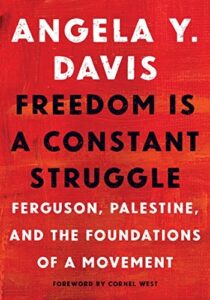
From the back cover: In these newly collected essays, interviews, and speeches, world-renowned activist and scholar Angela Y. Davis illuminates the connections between struggles against state violence and oppression throughout history and around the world.
Reflecting on the importance of Black feminism, intersectionality, and prison abolitionism for today’s struggles, Davis discusses the legacies of previous liberation struggles—from the Black freedom movement to the South African antiapartheid movement. She highlights connections and analyzes today’s struggles against state terror, from Ferguson to Palestine.
Facing a world of outrageous injustice, Davis challenges us to imagine and build the movement for human liberation. And in doing so, she reminds us that “freedom is a constant struggle.”

Description
From the back cover: What has befallen Gaza is a man-made humanitarian disaster. The Gaza Strip is among the most densely populated places in the world. More than two-thirds of its inhabitants are refugees, and more than half are under eighteen years of age. Since 2004, Israel has launched eight devastating “operations” against Gaza’s largely defenseless population. Thousands have perished, and tens of thousands have been left homeless. In the meantime, Israel has subjected Gaza to a merciless illegal blockade.
Based on scores of human rights reports, Norman G. Finkelstein’s book presents a meticulously researched inquest into Gaza’s martyrdom. He shows that although Israel has justified its assaults in the name of self-defense, in fact these actions constituted flagrant violations of international law. He also documents that the guardians of international law—from Amnesty International and Human Rights Watch to the UN Human Rights Council—ultimately failed Gaza. This magnum opus is both a monument to Gaza’s martyrs and an act of resistance against the forgetfulness of history.
Description
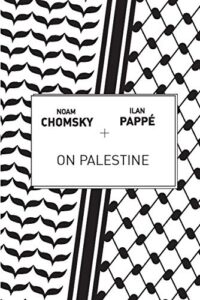
From the back cover: Operation Protective Edge, Israel’s most recent assault on Gaza, left thousands of Palestinians dead and cleared the way for another Israeli land grab. The need to stand in solidarity with Palestinians has never been greater. Ilan Pappé and Noam Chomsky, two leading voices in the struggle to liberate Palestine, discuss the road ahead for Palestinians and how the international community can pressure the United States and Israel to end their human rights abuses against the people of Palestine. On Palestine is the sequel to their acclaimed book Gaza in Crisis.
Description
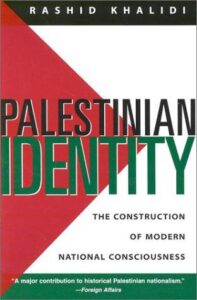
From the preface, in regards to how Khalidi narrowed his research from broad, already comprehensive Palestinian history to a more manageable scope: “In the end, I broadened its scope from Jerusalem to the entirety of Palestine, and shifted its focus from general intellectual history to a study of the emergence of Palestinian identity. I narrowed the focus because I felt that the issue of identity was perhaps the most important problem of Palestinian history which needed to be explained to both a general and an academic audience. If one takes identity as the answer to the question, “Who are you?” it is clear that the response of the inhabitants of Palestine has changed considerably over time. I sought to explain the reasons for that change.”

Description
From the preface: It is tempting to describe Mahmoud Darwish’s writing life through geography and history. His early poetry transformed the dispossessed land into the unattained beloved whose images inform the poet’s lexicon. The features of Palestine — its flowers and birds, towns and waters — became integrated in the poet’s witness to the string of tragedies, political and humanitarian, that have continued to afflict his people. Yet, over the decades, Darwish’s search beyond mere place never left him. Now, in his most recent poetry, translated in this volume, his writing stands clearly at the border of earth and sky, reality and myth, love and exile, poetry and prose.
Description
From the back cover: In 1967, Bashir Khairi, a twenty-five-year-old Palestinian, journeyed to Israel with the goal of seeing the beloved old stone house with the lemon tree behind it that he and his family had fled nineteen years earlier. To his surprise, when he found the house he was greeted by Dalia Eshkenazi Landau, a nineteen-year-old Israeli college student, whose family fled Europe for Israel following the Holocaust. On the stoop of their shared home, Dalia and Bashir began a rare friendship, forged in the aftermath of war and tested over the next thirty-five years in ways that neither could imagine on that summer day in 1967. Sandy Tolan brings the Israeli Palestinian conflict down to its most human level, suggesting that even amid the bleakest political realities there exist stories of hope and reconciliation.